



An unexpected vehicle accident disrupts your daily routine and introduces a complex series of decisions regarding structural integrity, safety standards, and insurance logistics. Navigating the aftermath of a collision requires professional guidance to ensure your vehicle is returned to its precise factory specifications. When a vehicle sustains impact damage, the structural, mechanical, and cosmetic systems must be evaluated as an interconnected whole rather than isolated components.
The collision recovery process begins with a comprehensive, multi-point assessment. Technicians document the visible external damage while performing diagnostic pre-scans to identify hidden electrical faults, safety-system codes, and structural shifts. Under Massachusetts law, a written appraisal of motor vehicle damage is strictly required before any collision repair work can commence. This appraisal must contain a highly detailed, itemized breakdown of the necessary replacement parts, labor hours, and the exact repair procedures required to restore the vehicle safely.
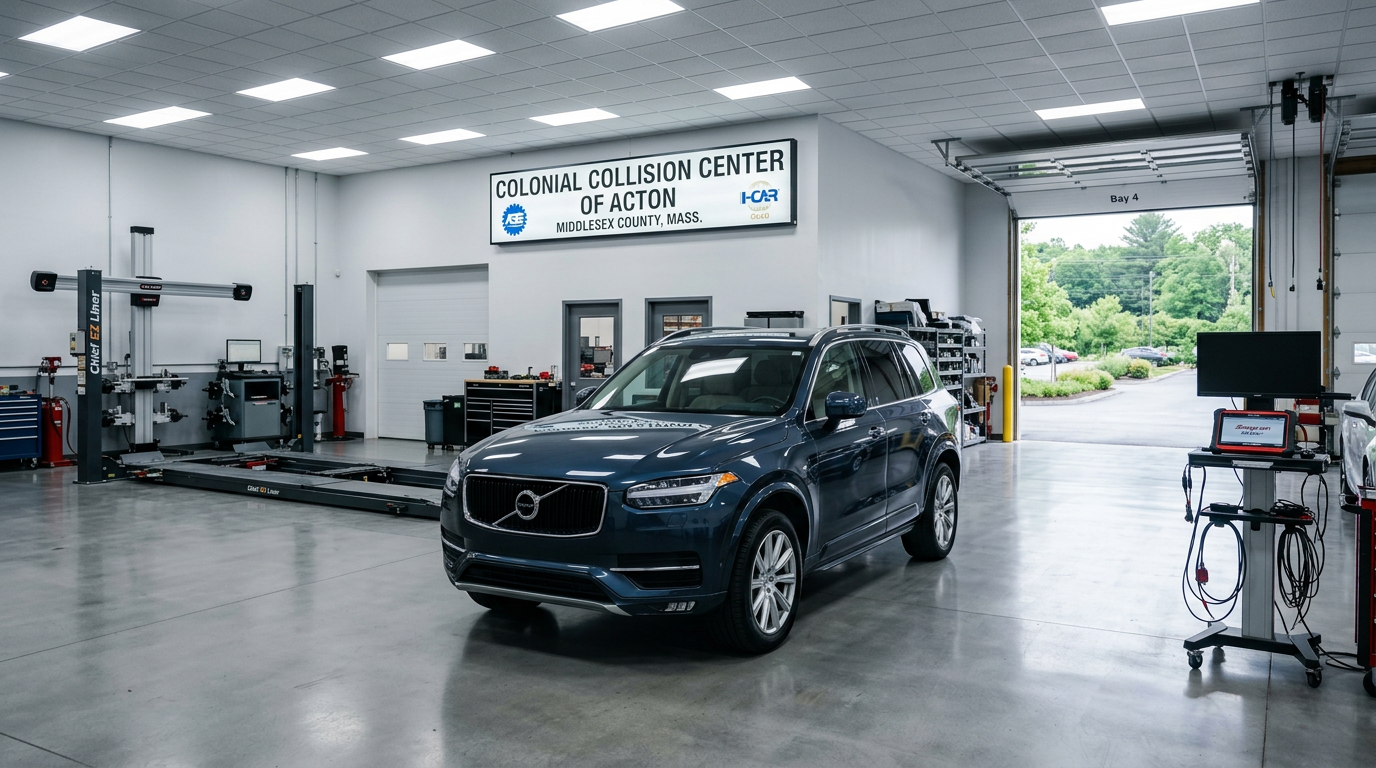
At Colonial Collision Center of Acton, we coordinate directly with insurance providers to streamline the transition from the initial appraisal to the final physical repairs. Our specialized facility is equipped with advanced diagnostic tools, heavy-duty frame-pulling machinery, and factory-approved refinishing systems to manage every stage of your vehicle’s recovery. If your vehicle requires immediate mechanical attention, structural assessment, or routine maintenance following an incident, you can easily schedule service with our factory-trained technicians.
To help local drivers manage the unexpected costs associated with post-accident recovery, we routinely update our available service and parts specials. Our team utilizes original manufacturer components to preserve the exact safety, durability, and crash-performance standards engineered into your vehicle. If you or an independent repair technician need to secure specific factory components, you can order parts directly through our dedicated parts department. For personalized assistance or to discuss your vehicle’s specific repair plan, please contact our service team by giving us a quick call today.
Table of Contents
- Comprehensive Care for Minor Body Damage and Major Structural Collision Repair
- Navigating the Insurance Claims Process and Deductibles
- Understanding Advanced Safety Systems: Static vs Dynamic ADAS Calibration
- Why I-CAR Gold Class Certification Matters for Your Vehicle’s Safety
- Key Questions to Ask Before Choosing Your Collision Repair Facility
- Restoring Safety and Performance with Certified Chevrolet Collision Support
- Common Questions About Collision Repair and Insurance
Comprehensive Care for Minor Body Damage and Major Structural Collision Repair
Does a professional collision center handle both minor body damage and major structural repairs? A fully equipped facility must be capable of managing the entire spectrum of auto body restoration, as seemingly superficial surface damage often masks deeper structural compromises.
Minor body damage typically involves cosmetic imperfections that do not affect the underlying safety or structural performance of the vehicle. These common repairs include:
- Paintless dent repair for minor door dings and hail damage
- Surface scratch removal and precision paint blending
- Bumper cover reconditioning or replacement
- Cosmetic alloy wheel refinishing
- Replacement of cracked glass, side mirrors, and exterior trim panels
Major collision repair, by contrast, addresses the structural integrity of the vehicle’s frame or unibody construction. During a severe impact, a vehicle’s crumple zones are engineered to deform and absorb kinetic energy, protecting the passenger cabin. Restoring these structures requires heavy-duty frame racks and computerized three-dimensional measuring systems. Technicians utilize laser-guided coordinates to compare the vehicle’s real-time physical dimensions against original factory specifications, pulling the frame back to its exact structural tolerances.
Verifying structural alignment accuracy is critical before any cosmetic panels are reinstalled. For full-frame vehicles, such as trucks and larger SUVs, specific frame sections can occasionally be isolated, straightened, or replaced. Unibody vehicles, which integrate the body and frame into a single load-bearing structure, require specialized welding and pulling techniques to ensure the high-strength steel behaves correctly in any future impacts.
Navigating the Insurance Claims Process and Deductibles
Who is responsible for paying the deductible for a collision repair? The policyholder is legally responsible for paying the designated insurance deductible directly to the collision repair facility once all authorized repairs are completed and the vehicle is ready for pickup. The deductible represents the out-of-pocket portion of the insurance policy that the driver agreed to pay when establishing their coverage.
The insurance claims process in Massachusetts follows a structured path designed to protect the consumer while ensuring vehicle safety:
- Initial Claim Filing: The policyholder reports the incident to their insurance provider to initiate the claim and obtain a claim number.
- The Written Appraisal: A licensed appraiser inspects the vehicle and generates a detailed, itemized appraisal of the visible damage.
- Teardown and Disassembly: The repair facility partially disassembles the damaged areas to inspect for hidden structural, mechanical, or electrical issues.
- Supplemental Estimates: If hidden damage is discovered during teardown, the shop submits a supplemental estimate to the insurance company for approval before proceeding with those additional repairs.
- Repair and Refinishing: Technicians complete the structural, mechanical, and paint work according to manufacturer guidelines.
- Deductible Payment and Vehicle Release: The customer pays the deductible to the shop, the insurer pays the remaining balance, and the vehicle is released.
Many drivers wonder if insurance companies are allowed to recommend specific body shops in Massachusetts. While insurance providers are legally permitted to suggest a list of preferred or referral repair facilities, they must explicitly inform you that you are under no obligation to use them. Under state law, you retain the absolute right to choose any licensed collision repair facility to perform your vehicle’s body and structural work. Selecting a shop that prioritizes manufacturer-required repair procedures over insurance-preferred cost-cutting measures ensures your vehicle is repaired to original safety standards.
Understanding Advanced Safety Systems: Static vs Dynamic ADAS Calibration
What is the difference between static and dynamic ADAS calibration? Modern vehicles are equipped with Advanced Driver Assistance Systems (ADAS) that rely on a complex network of cameras, radar sensors, ultrasonic sensors, and lidars. These systems govern critical safety features, including automatic emergency braking, lane-keep assist, adaptive cruise control, and blind-spot monitoring. Following any collision repair, windshield replacement, wheel alignment, or suspension alteration, these sensors must be precisely calibrated to ensure they interpret the surrounding environment accurately.
Static calibration is performed inside a highly controlled shop environment. This process requires a flat, level floor, specialized lighting, and precise physical targets or alignment screens placed at exact distances and angles from the vehicle. Technicians utilize electronic lasers and specialized software to align the vehicle’s internal cameras and sensors with these physical targets. This method is highly technical and must be conducted while the vehicle is completely stationary to establish an accurate baseline.
Dynamic calibration, conversely, is performed while driving the vehicle on public roads. This process requires the technician to operate the vehicle at specific, steady speeds on well-marked roads under clear weather conditions. The vehicle’s onboard computer monitors the road markings, surrounding traffic, and roadside structures to calibrate the cameras and radar sensors in real-world driving scenarios.
Many modern vehicles require a combination of both static and dynamic calibration to fully restore all driver-assist safety functions. Failing to perform these manufacturer-required calibrations can cause safety systems to malfunction, trigger dashboard warning lights, or fail to intervene during a critical driving event.
Why I-CAR Gold Class Certification Matters for Your Vehicle’s Safety
What is an I-CAR Gold Class certification, and why should it influence your choice of a collision repair facility? The Inter-Industry Conference on Auto Collision Repair (I-CAR) is an international non-profit organization dedicated to providing the information, skills, and training required to perform safe, high-quality collision repairs. The Gold Class designation is the highest level of training achievement recognized within the collision repair industry.
To achieve and maintain Gold Class certification, a repair facility must commit to continuous, annual training for its entire technical staff. This rigorous program ensures that technicians are thoroughly educated on the latest automotive technologies, advanced materials, and repair methodologies. Vehicle construction has evolved rapidly, incorporating mixed materials such as high-strength steel, aluminum, carbon fiber, and complex composites. Each of these materials requires distinct handling, specialized welding techniques, and unique equipment to repair without compromising structural integrity.
When a collision facility holds a Gold Class certification, it signifies that their technicians possess up-to-date knowledge regarding:
- Advanced structural repair and computerized frame measuring
- Proper welding techniques for high-strength steels and aluminum
- Safe handling and repair of hybrid and electric vehicle high-voltage systems
- Accurate ADAS sensor identification and calibration requirements
- Industry-standard refinishing and corrosion protection application
Entrusting your vehicle to a certified facility ensures that the technicians working on your car understand how to execute manufacturer-required procedures, preserving the vehicle’s original safety ratings and crashworthiness.
Key Questions to Ask Before Choosing Your Collision Repair Facility
What should you ask a body shop before leaving your vehicle for repairs? Selecting the right collision center requires verifying that the facility possesses the training, equipment, and customer service standards necessary to handle your repair professionally. Asking targeted questions before authorizing any work can prevent communication issues and ensure a high-quality result.
Consider asking the following essential questions during your initial consultation:
- Do you hold current certifications, such as I-CAR Gold Class or manufacturer-specific credentials? This confirms the technical staff undergoes regular training on modern vehicle structures.
- Do you use original equipment manufacturer parts, or do you default to aftermarket components? Utilizing factory-original parts ensures proper fit, finish, and structural performance.
- How do you handle the insurance supplement process if hidden damage is discovered? A professional shop should manage all communication, digital photo documentation, and supplemental approvals directly with your insurance adjuster.
- Do you perform pre- and post-repair diagnostic scans and ADAS calibrations in-house? Verifying that safety sensors are electronically scanned and calibrated is critical for modern vehicle safety.
- Do you provide a written warranty on your workmanship and paint refinishing? Reputable shops stand behind their structural repairs and paint matching with a clear, written guarantee.
Restoring Safety and Performance with Certified Chevrolet Collision Support
When your vehicle requires professional attention after an accident, choosing a repair center that understands the engineering of your vehicle is the most critical step toward recovery. For drivers navigating the commuter corridors around Acton, ensuring your vehicle’s structural frame and advanced safety sensors are restored to factory standards is essential for daily peace of mind. Our team is committed to utilizing original equipment parts and manufacturer-approved techniques to return your vehicle to its pre-accident safety, durability, and performance levels.
If you are managing the logistics of a recent collision in Stow, our staff can assist with the insurance coordination, detailed damage appraisals, and structural measurements required to initiate your claim smoothly. We focus on transparent communication, technical precision, and thorough quality-control inspections to ensure every repair meets rigorous industry standards.
To discuss your vehicle’s repair needs, coordinate an estimate, or speak with our service coordinators, please contact our team directly. For turn-by-turn directions to our facility, you can view our location at 171 Great Rd, Acton, MA 01720. To speak with a service professional immediately, give us a call at (978) 206-1952 to schedule your initial damage assessment.
Common Questions About Collision Repair and Insurance
Q: What is the difference between a full-frame and a unibody construction during a collision repair?
A: Full-frame vehicles feature a heavy, independent steel frame with the body mounted on top, allowing specific frame sections to be pulled or replaced independently if damaged. Unibody vehicles integrate the body and frame into a single, cohesive structure designed to distribute impact energy through built-in crumple zones, requiring highly precise computerized measuring and specialized welding to repair safely.
Q: Can a vehicle be safely driven on public roads if the frame has been bent and subsequently straightened?
A: Yes, a vehicle can be driven safely after frame repair, provided the work was completed by certified technicians using computerized three-dimensional measuring systems. These systems compare the vehicle’s structural coordinates against the manufacturer’s original factory specifications to ensure the frame is restored to its exact original dimensions and structural integrity.
Q: How do technicians verify that a vehicle’s structural frame alignment is completely accurate before completing repairs?
A: Technicians utilize electronic three-dimensional laser measuring systems that attach to specific targeting points on the vehicle’s chassis. These systems compare real-time physical measurements against the manufacturer’s exact dimensional database, confirming the vehicle’s frame or unibody structure is perfectly aligned before cosmetic panels are reinstalled.
Q: What paperwork and items should I bring to the collision center for my initial repair estimate?
A: You should bring your insurance company’s name, your claim number, a copy of the initial insurance appraiser’s written estimate if one was already performed, and your vehicle’s registration. Having these documents organized allows the collision center to communicate directly with your insurance adjuster and expedite the approval of any necessary repair supplements.
© 2026 Colonial Chevrolet. All rights reserved.
Connect with us


