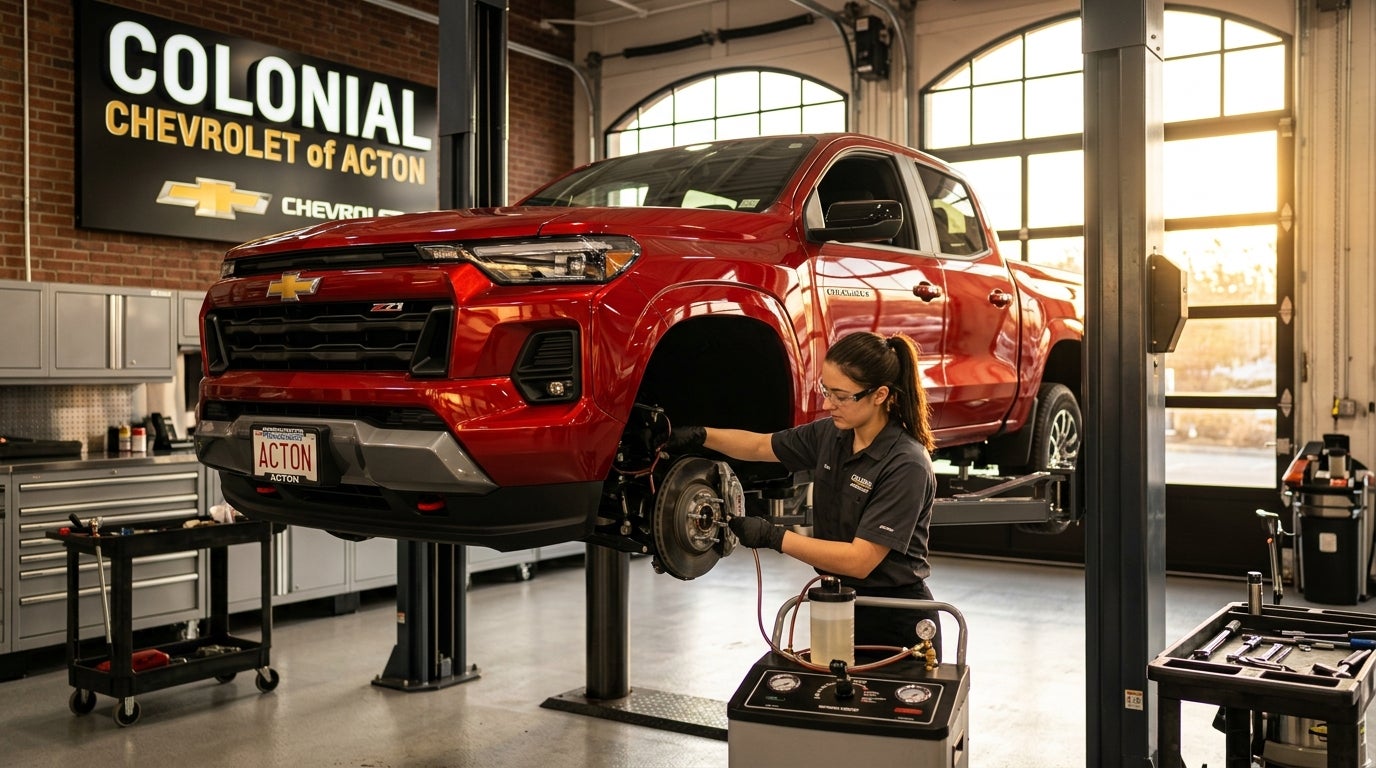





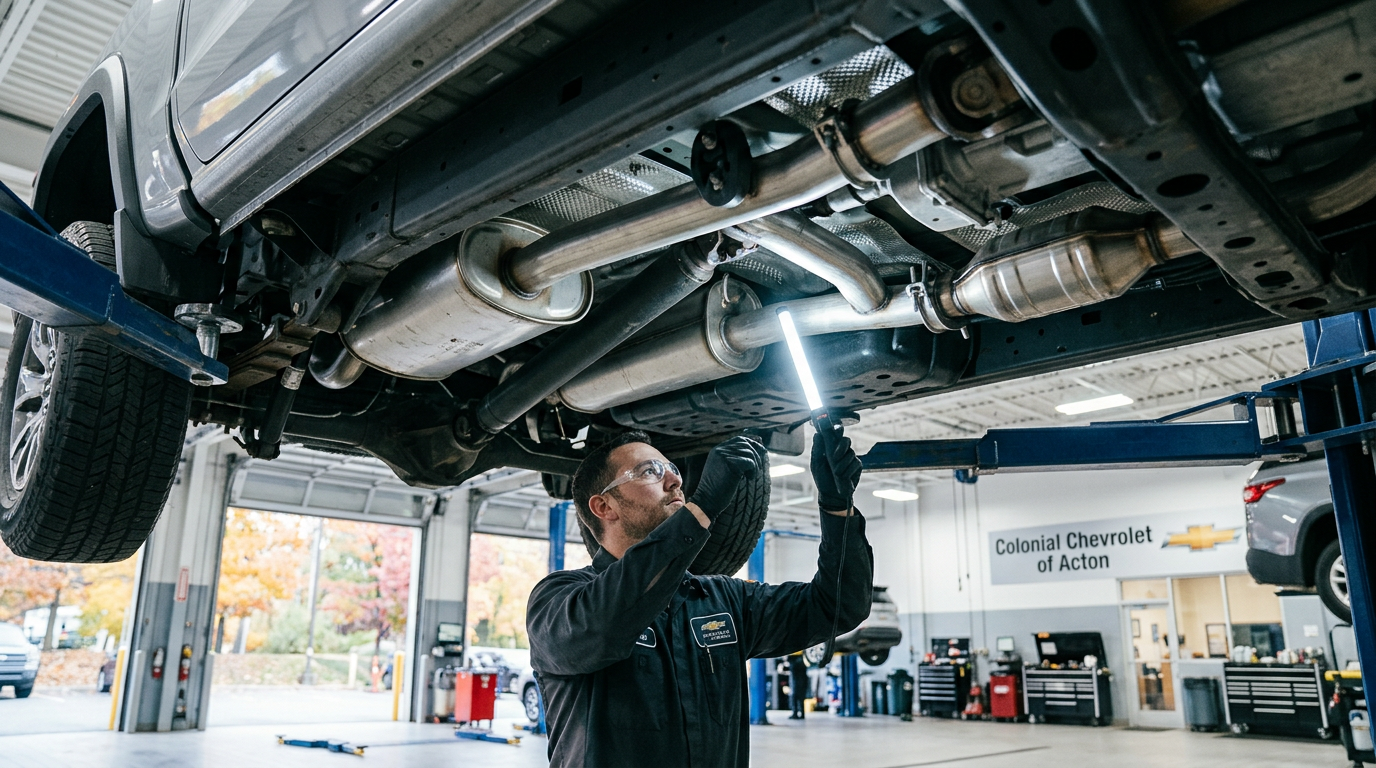
A Chevrolet exhaust system requires professional repair immediately upon exhibiting deep rumbling or loud roaring noises, a metallic ticking sound during acceleration, visible rust holes, excessive tailpipe vibration, or any exhaust odor inside the passenger cabin. Prompt service is also necessary if a check-engine light illuminates, as an undetected leak or failed oxygen sensor can trigger an automatic rejection during mandatory Massachusetts state safety and OBD emissions inspections.
The vehicle exhaust system plays three critical roles: directing hazardous carbon monoxide gas away from passengers, dampening intense combustion noise, and treating raw exhaust emissions before releasing them into the atmosphere. When components degrade, safety and performance suffer quickly. Rust holes, fractured flex pipes, worn isolation hangers, and corroded flange connections allow pressurized, high-temperature gases to escape beneath the floorboards. In winter conditions, road salt applied along primary corridors like Great Road in Acton accelerates metal oxidation along lower exhaust piping and muffler seams. If dangerous combustion fumes creep into the cabin, driving safety becomes immediately compromised.
Ignoring minor exhaust leaks leads to costly secondary damage. Unfiltered exhaust heat escaping near the underside of the vehicle can scorch heat shielding, bake fuel lines, and melt synthetic wiring harnesses. Furthermore, exhaust leaks occurring upstream from the catalytic converter draw outside air into the pipe, tricking internal engine control sensors into over-delivering fuel. This unnecessary fuel consumption degrades fuel efficiency and severely overheats the internal substrate of the catalytic converter.
Recognizing early warning signs prevents roadside breakdowns and costly component failures. Vehicle owners who notice unexpected exhaust harshness or unusual underbody rattles can bring their truck, SUV, or sedan to our Acton service center for a complete visual and diagnostic lift inspection, or call our team directly at (978) 206-1952 to discuss specific exhaust symptoms.
Table of Contents
- What Do Exhaust Resonators and Oxygen Sensors Do on a Chevrolet?
- What Happens When a Chevrolet Exhaust Manifold Gasket Leaks?
- What Factors Cause the Price of Chevrolet Exhaust Repairs to Vary?
- Common Questions About Chevrolet Exhaust and Muffler Service
- Keep Your Exhaust System Running Smoothly
What Do Exhaust Resonators and Oxygen Sensors Do on a Chevrolet?
An exhaust resonator works in tandem with the muffler to eliminate harsh, high-frequency sound waves and cabin drone, while oxygen sensors continuously measure unburned oxygen levels in the exhaust stream to keep the engine operating at peak combustion efficiency. Together, these components maintain refined cabin noise levels, protect engine health, and satisfy state environmental regulations.
| CHEVROLET EXHAUST SYSTEM FLOW |
|---|
| [Engine Manifold] -> [Upstream O2 Sensor] -> [Catalytic Converter] |
| -> [Downstream O2 Sensor] -> [Resonator] -> [Muffler] -> [Tailpipe Output] |
Engine combustion produces intense sound waves that travel through the exhaust piping at high velocity. The exhaust resonator acts as an acoustical expansion chamber engineered specifically for your vehicle's engine displace and cylinder configuration. Sound waves enter the internal cavity of the resonator, bounce off targeted internal baffles, and bounce back out of phase. This destructive wave interference cancels out irritating low-frequency drone noises before exhaust gases reach the main muffler. Removing or ignoring a damaged resonator results in unpleasant cabin buzzing during highway cruising speed.
Oxygen sensors act as the central feedback system for modern engine control module systems. Most modern Chevrolet engine layouts feature both upstream and downstream oxygen sensors:
- Upstream Oxygen Sensors: Positioned in the exhaust manifold or front pipe before the catalytic converter, these sensors measure unburned oxygen in raw exhaust gas. The engine control module uses this real-time data to adjust closed-loop fuel delivery thousands of times per minute.
- Downstream Oxygen Sensors: Located directly behind the catalytic converter, these sensors monitor catalyst conversion efficiency. When a downstream sensor detects fluctuating oxygen levels similar to the upstream sensor, it flags a catalyst efficiency fault code.
| Component | Primary Function | Common Failure Symptom | Impact on Vehicle Performance |
|---|---|---|---|
| Resonator | Cancels specific sound frequencies and cruising drone | Metallic rattle or deep cabin hum | Annoying cabin acoustics without power loss |
| Upstream O2 Sensor | Measures unburned oxygen to regulate air-fuel mixture | Check engine light, rich fuel smell | Reduced fuel efficiency and spark plug fouling |
| Downstream O2 Sensor | Monitors catalytic converter health | Check engine light with code P0420 | Failed state emissions inspection |
When an oxygen sensor deteriorates, sluggish response times cause the engine control module to run rich, wasting fuel and clogging spark plugs. Drivers looking to maintain their vehicle's fuel efficiency can check current service and parts specials for sensor testing and exhaust maintenance promotions.
What Happens When a Chevrolet Exhaust Manifold Gasket Leaks?
A leaking Chevrolet exhaust manifold gasket permits high-temperature combustion gas to escape directly at the engine cylinder head mating surface, generating a loud ticking sound during acceleration and drawing ambient air into the exhaust manifold. This breach compromises engine performance, damages surrounding engine bay components, and triggers active error codes.
The exhaust manifold attaches directly to the cylinder head, collecting raw combustion gases from each cylinder port. Sealed by a multi-layer steel or composite gasket, this joint experiences extreme thermal cycling every time the engine starts and reaches operating temperature. Over tens of thousands of thermal cycles, engine heat warps manifold mounting flanges, stretches manifold studs, and degrades the sealing gasket. Once a breach forms, pressurized combustion gas blasts past the gasket, producing a distinctive metallic ticking sound that grows louder when pressing the accelerator pedal under load.
A leaking exhaust manifold gasket introduces serious operational issues across several vehicle systems:
- False Lean Diagnostic Signals: The pulsed flow of escaping exhaust creates a negative pressure wave inside the manifold, sucking outside air past the leaking gasket. The upstream oxygen sensor detects this extra oxygen and signals the engine control module that the engine is running lean. The computer responds by injecting excess gasoline, causing unburnt fuel to wash down cylinder walls and contaminate engine oil.
- Underhood Thermal Damage: Raw exhaust gases exit the manifold joint at temperatures exceeding 1,200 degrees Fahrenheit. This intense, targeted heat jet can melt adjacent wiring harnesses, warp plastic engine covers, crack nearby vacuum lines, and destroy ignition coil boots.
- Broken Mounting Hardware: Thermal warping puts immense lateral shear pressure on steel manifold bolts. As the gasket deteriorates, loose bolts fracture inside the aluminum cylinder head, requiring precision extraction during repair.
Replacing a failed exhaust manifold gasket involves removing heat shields, unbolting exhaust pipes, extracting broken studs, and resurfacing warped manifold mating faces to guarantee a lasting flush seal.
What Factors Cause the Price of Chevrolet Exhaust Repairs to Vary?
The overall cost of Chevrolet exhaust service varies depending on which specific component requires replacement, the quality of construction materials, structural welding demands, and the labor required to remove seized hardware. Diagnosing the exact location of exhaust leakage ensures vehicle owners only pay for the necessary repair scope.
EXHAUST MATERIAL COMPARISON MATRIX
| Material Type | Rust Resistance | Lifespan Expectancy | Application |
|---|---|---|---|
| Heavy Aluminized Steel | Moderate | 3 to 5 Years | Budget-Friendly |
| 409 Stainless Steel | High | 8 to 10 Years | OEM Standard |
| 304 Stainless Steel | Exceptional | Lifetime | Premium Grade |
Component selection represents a primary cost driver. Swapping a rusted bolt-on tailpipe section requires significantly less labor and component cost than replacing a combined catalytic converter and exhaust manifold assembly featuring integrated sensors. Additionally, material selection impacts longevity and price:
- Aluminized Steel: Lowers initial repair costs, making it a budget-conscious choice for short-term fixes, though it wears faster when exposed to northern winter road salts.
- Stainless Steel: Direct-fit 409-grade stainless steel or high-tensile 304-grade stainless steel components cost more up front but offer superior corrosion resistance along open back roads in Stow, resisting salt pitting and extending exhaust system life.
Labor requirements also vary based on vehicle age and hardware condition. Exhaust systems operate beneath the chassis in high-moisture environments. Flange bolts and exhaust clamps frequently rust solid, requiring technicians to use induction heating tools or cutting torches to dismantle frozen joints without damaging adjacent floorboards. While universal mufflers cost less up front, fitting them often requires custom pipe bending, expanding, and MIG welding. In contrast, direct-fit OEM replacement assemblies bolt directly to factory hanger points, saving labor time and ensuring precise tailpipe clearance.
Vehicle owners seeking an accurate diagnostic estimate can proceed by scheduling an exhaust inspection or ordering genuine OEM exhaust components directly from our certified parts counter.
Common Questions About Chevrolet Exhaust and Muffler Service
Q: How long does a typical Chevrolet muffler replacement take?
A standard Chevrolet muffler replacement usually takes between 1 and 2 hours when performed by a factory-trained technician using direct-fit replacement parts. If severe rust contamination requires heating seized flange bolts, custom pipe cutting, or replacing rusted rubber isolation hangers, the procedure may take longer.
Q: Does installing an aftermarket exhaust void the Chevrolet factory warranty?
Installing an aftermarket exhaust system does not automatically void your Chevrolet factory warranty. Coverage remains fully intact unless the specific aftermarket component directly causes a failure in another factory engine, electrical, or emissions system part.
Q: Can independent auto repair shops perform Chevrolet exhaust repairs?
Independent auto repair facilities can perform basic exhaust pipe welding, universal muffler installations, and standard sensor replacements. However, authorized Chevrolet service centers provide factory-trained technicians, specialized lift tooling, direct-fit OEM components, and full access to official brand technical bulletins.
Q: Why does my Chevrolet make a loud roaring noise when I accelerate?
A loud roaring sound during acceleration almost always signals an exhaust breach located before or within the muffler. Common causes include a rusted-out muffler shell, a severed exhaust pipe joint, or a blown flange gasket separating major exhaust pipe sections.
Q: Will an exhaust leak cause a Chevrolet to fail Massachusetts state inspection?
Yes, any detectable exhaust gas leak or active check-engine light caused by an exhaust system fault results in an immediate failure during mandatory annual Massachusetts vehicle inspections. State safety regulations strictly forbid exhaust gas leakage anywhere along the system piping.
Keep Your Exhaust System Running Smoothly
Maintaining a quiet, efficient, and emissions-compliant exhaust system protects engine health, preserves interior air quality, and ensures year-round driving confidence. Addressing ticking noises, underbody rattles, or active check-engine lights early prevents minor gasket or pipe leaks from escalating into major component failures.
Our factory-trained technicians inspect exhaust systems using genuine original equipment parts, precision welding equipment, and advanced diagnostic software. Whether your vehicle requires an oxygen sensor replacement, manifold gasket repair, or full stainless-steel muffler installation, our team provides reliable fixed-operations care.
For certified exhaust repairs and system diagnostics, visit our Acton service department at 171 Great Rd, Acton, MA 01720 or speak with a service consultant by calling (978) 206-1952 today.
© 2026 Colonial Chevrolet. All rights reserved.