





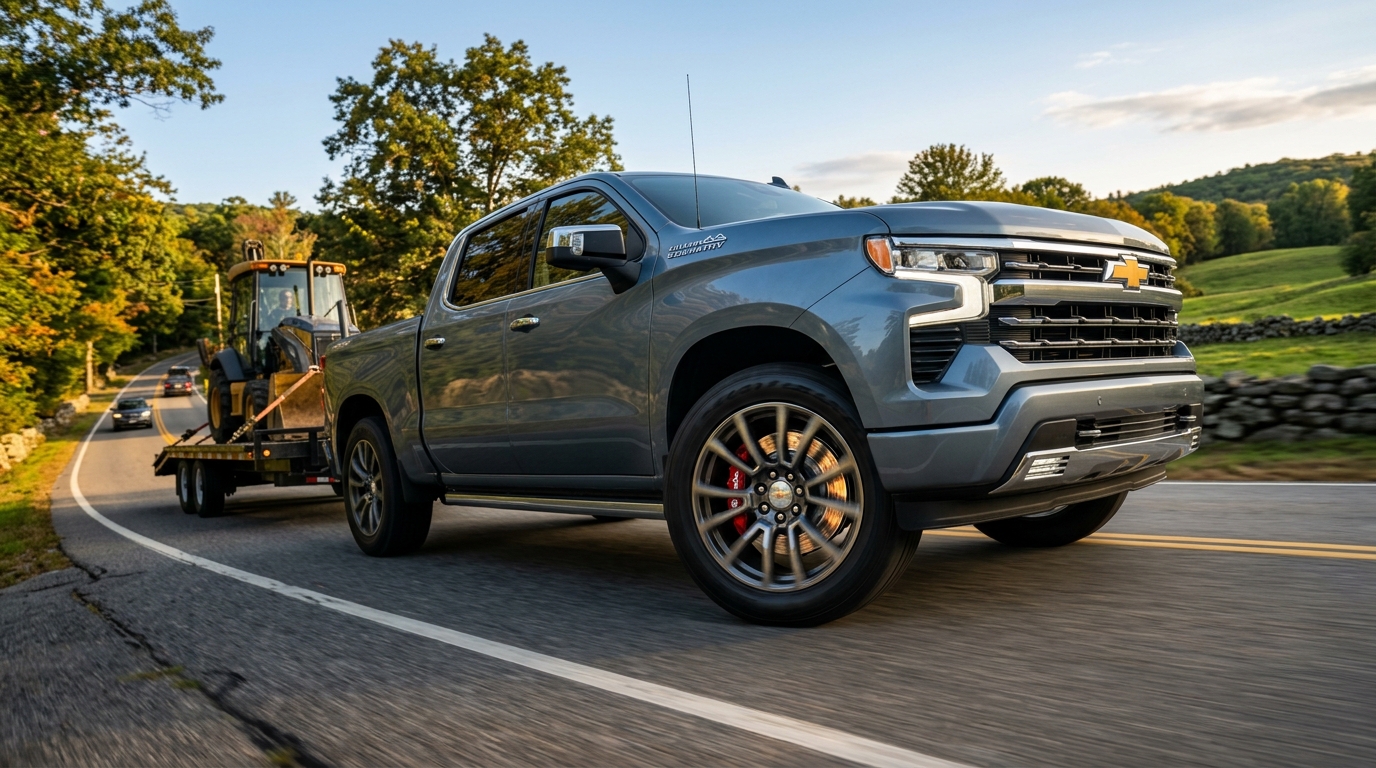
Maintaining Peak Stopping Power for the 2026 Chevrolet Silverado 1500
The heavy-duty demands placed on a full-size truck mean that the braking system is under constant thermal and mechanical stress. For the 2026 Chevrolet Silverado 1500, maintaining stopping power is not just about comfort; it is a critical safety requirement, especially when utilizing the 13,300 lbs max available towing capacity. Whether you are hauling equipment to a job site or navigating the suburban traffic in Acton, the friction material on your brake pads and the integrity of your rotors determine how effectively the vehicle can dissipate kinetic energy. Our team focuses on ensuring these components meet the specific tolerances required for the 5.3L V8 and other high-output powertrains.
Standard maintenance for the Silverado 1500 involves more than just a visual check of the pads. Because this truck utilizes an electric parking brake and complex electronic stability controls, the hydraulic system must be kept free of moisture and contaminants. We recommend a comprehensive inspection at every tire rotation, or roughly every 7,500 miles, to ensure the calipers are sliding freely and the pad wear is even across both axles. If you notice a change in pedal feel while driving through the rolling terrain of Middlesex County, you can reach our service advisors at (978) 206-1952 to discuss a diagnostic appointment.
Proactive care is particularly important for truck owners who frequently engage in heavy trailering. The heat generated during repeated stops with a heavy load can lead to glazed pads or warped rotors, which diminishes the effectiveness of the Automatic Emergency Braking and other safety systems. If you need to drop off your vehicle for a professional evaluation, you can find our service center location right on Great Rd, where our certified technicians use specialized equipment to measure rotor thickness and run-out.
Table of Contents
- Standard Brake Specifications and the Durability of Duralife Rotors
- Mastering Steep Grades with Powertrain and Cruise Grade Braking
- Essential Signs Your Silverado Needs Professional Brake Service
- Comparing Silverado 1500 Braking Performance Against the Ford F-150
- Expert Answers to Common Silverado Brake Maintenance Questions
Standard Brake Specifications and the Durability of Duralife Rotors
The 2026 Chevrolet Silverado 1500 is engineered with a four-wheel disc brake system that features Duralife brake rotors. These rotors undergo a Ferritic Nitro-Carburizing (FNC) process, a specialized hardening treatment that creates a corrosion-resistant surface. This technology is essential for drivers in the salt-belt, where winter road treatments can quickly lead to surface rust and “pitting” on standard steel rotors. By hardening the rotor surface, Chevrolet has designed a system that can last up to twice as long as conventional rotors while reducing pedal pulsation caused by uneven wear.
Technical specifications for the 2026 model year emphasize consistent performance across the trim lineup, from the Work Truck to the High Country. The front rotors typically measure approximately 13 inches, while the rear vented discs are slightly larger at 13.6 inches to handle the weight distribution of a loaded bed. When it comes time for replacement, using genuine OEM parts is vital to maintain the original braking signature and ensure compatibility with the StabiliTrak electronic stability control system. To help manage the cost of these essential repairs, we often provide service and parts specials that cover common maintenance items.
Maintaining the hydraulic integrity of the system is just as important as the hardware. The 2026 Silverado generally requires DOT 4 brake fluid, which has a higher boiling point than older fluid types, providing better protection against brake fade during intense use. Over time, brake fluid absorbs moisture, which can lead to internal corrosion of the ABS module and calipers. To prevent these expensive repairs, we suggest a fluid flush every two to three years. You can easily schedule a brake inspection online to have our team verify your fluid levels and pad thickness.
Mastering Steep Grades with Powertrain and Cruise Grade Braking
One of the most advanced features of the Silverado 1500 braking architecture is the integration of Cruise Grade Braking and Powertrain Grade Braking. These systems are designed to reduce the burden on the physical brake pads and rotors when descending long, steep hills. When the truck is in Tow/Haul Mode, the transmission and engine work together to provide downshifts that use engine compression to slow the vehicle. This is standard on models equipped with the TurboMax engine and the Duramax 3.0L Turbo-Diesel, helping to prevent the friction brakes from overheating and losing effectiveness.
In addition to engine-based slowing, the available Integrated Trailer Brake Controller allows the driver to adjust the amount of braking force applied to the trailer’s electric brakes directly from the dashboard. This works in tandem with Trailer Sway Control, which can automatically apply the truck’s brakes if it senses the trailer is beginning to oscillate. For owners in Stow who frequently pull horse trailers or boats, these integrated systems provide a level of control that aftermarket controllers often lack. Ensuring these electronic connections are clean and functional is a standard part of our specialized trailering service.
If you prefer to perform minor maintenance yourself, such as replacing the air filters that keep your engine running efficiently for grade braking, you can order genuine Chevrolet parts through our dedicated department. However, because the Silverado uses an electric parking brake, a specialized scan tool is often required to retract the rear calipers into “service mode.” Attempting to force the pistons back without this electronic command can damage the internal motor mechanism, making professional service the safer choice for modern truck owners.
Essential Signs Your Silverado Needs Professional Brake Service
Recognizing the early warning signs of brake wear can prevent a minor pad replacement from turning into a costly rotor and caliper overhaul. The most common indicator is a high-pitched squealing noise, which is caused by a small metal wear sensor on the brake pad contacting the rotor. This is a deliberate design feature intended to alert you that the friction material has reached its minimum safe thickness. If this sound transitions into a harsh grinding or growling noise, it typically means the pad material is completely gone and metal-to-metal contact is damaging the Duralife brake rotors.
Vibration or pulsation felt through the brake pedal or steering wheel is another clear signal that service is required. This often indicates “disc thickness variation,” where the rotor surface has developed thin and thick spots due to excessive heat or improper lug nut torque. In a heavy-duty vehicle like the Silverado 1500, these vibrations can become quite pronounced when stopping from highway speeds. Additionally, if the brake pedal feels “spongy” or travels further toward the floor than usual, there may be air in the hydraulic lines or a leak in the system that requires immediate attention.
Drivers should also keep an eye on the dashboard for the brake warning light or messages related to the ABS or StabiliTrak systems. Modern Silverados are equipped with sophisticated sensors that monitor fluid pressure and electronic actuator performance. A light on the dash could indicate anything from a low fluid level to a fault in the electric parking brake system. Given that these trucks are often used for hauling heavy loads, any compromise in the braking system’s hydraulic or electronic integrity should be treated as an urgent repair.
Comparing Silverado 1500 Braking Performance Against the Ford F-150
When comparing the braking systems of the 2026 Chevrolet Silverado 1500 and the 2026 Ford F-150, the differences lie primarily in the rotor technology and the integration of driver-assist features. Chevrolet’s use of Duralife brake rotors provides a distinct advantage in terms of long-term durability and resistance to the cosmetic rust that often plagues trucks parked outdoors. While the Ford F-150 utilizes an electronic brake boost system to support its hybrid powertrains, the Silverado focuses on mechanical longevity through its nitro-carburized rotor surfaces, which are specifically designed to resist the warping that can occur during the 13,300 lbs max available towing scenarios.
In terms of driver assistance, both trucks offer advanced safety suites. The Silverado features Forward Collision Alert and Front Pedestrian Braking as part of the standard Chevy Safety Assist package. However, the Silverado’s available Super Cruise technology offers a unique advantage by allowing for hands-free driving even while trailering on compatible roads. This system integrates with the braking hardware to manage following distances and stopping transitions more smoothly than many traditional adaptive cruise control systems, providing a more relaxed experience during long hauls across Massachusetts.
The feedback provided by the brake pedal is another area where the Silverado often stands out. Independent testing frequently notes that the Silverado provides a firm, progressive pedal feel that is easy to modulate, whereas the electronic-boosted systems in the F-150 can feel inconsistent at low speeds. For the 2026 model year, Chevrolet has refined the calibration of the Automatic Emergency Braking to reduce false positives while maintaining a high level of sensitivity, ensuring the truck remains a leader in active safety performance.
Expert Answers to Common Silverado Brake Maintenance Questions
Q: How often should I have the brakes on my 2026 Silverado 1500 inspected?
We recommend a professional brake inspection at every oil change or tire rotation, which typically occurs every 7,500 miles. Regular checks allow our technicians to monitor the wear rate of your pads and ensure the Duralife brake rotors remain free of deep scoring or heat damage. If you frequently tow heavy trailers or drive in stop-and-go traffic, more frequent inspections may be necessary to ensure peak performance.
Q: What is the typical lifespan of the brake pads on a new Silverado?
Brake pad life varies significantly based on driving habits and load, but most owners see between 30,000 and 60,000 miles before needing a replacement. Trucks used primarily for highway commuting will generally see longer life, while those used for heavy hauling or frequent mountain driving will require service sooner. Utilizing features like Powertrain Grade Braking can help extend the life of your friction materials by using the engine to assist in slowing the vehicle.
Q: Why does my Silverado 1500 require a specific type of brake fluid?
The 2026 Silverado is designed to use high-performance brake fluid, such as DOT 4, to handle the high temperatures generated by a full-size truck’s braking system. Using the wrong fluid can lead to a lower boiling point, which increases the risk of brake fade during heavy use. It can also cause the seals within the master cylinder and calipers to degrade prematurely, leading to hydraulic leaks.
Q: Can I change the brake pads on my Silverado myself if it has an electric parking brake?
While it is possible for a dedicated DIYer, the electric parking brake requires the vehicle to be placed into a specific “Service Mode” to safely retract the rear calipers. This is usually done via the infotainment screen or a professional scan tool. Attempting to manually compress the rear caliper pistons without engaging this mode can permanently damage the electronic parking brake actuators, leading to a much more expensive repair.
Q: Does the Chevrolet warranty cover brake pad and rotor replacement?
The basic 3 years / 36,000 miles warranty covers manufacturing defects in the braking system, such as a failing master cylinder or a defective ABS module. However, brake pads and rotors are considered “wear items,” similar to tires or wiper blades, and are typically not covered under the standard limited warranty unless they fail prematurely due to a defect. Our team can review your specific coverage and any available maintenance plans when you visit us.
If you have noticed any changes in your truck’s stopping performance, we invite you to visit Colonial Chevrolet in Acton for a thorough evaluation. Keeping your truck in top mechanical condition is our priority, and we are ready to help you maintain the reliability you expect from the Silverado nameplate. You can reach our service desk by giving us a quick call to discuss your maintenance needs or to ask about current part availability.
© 2026 Colonial Chevrolet. All rights reserved.
Connect with us


