





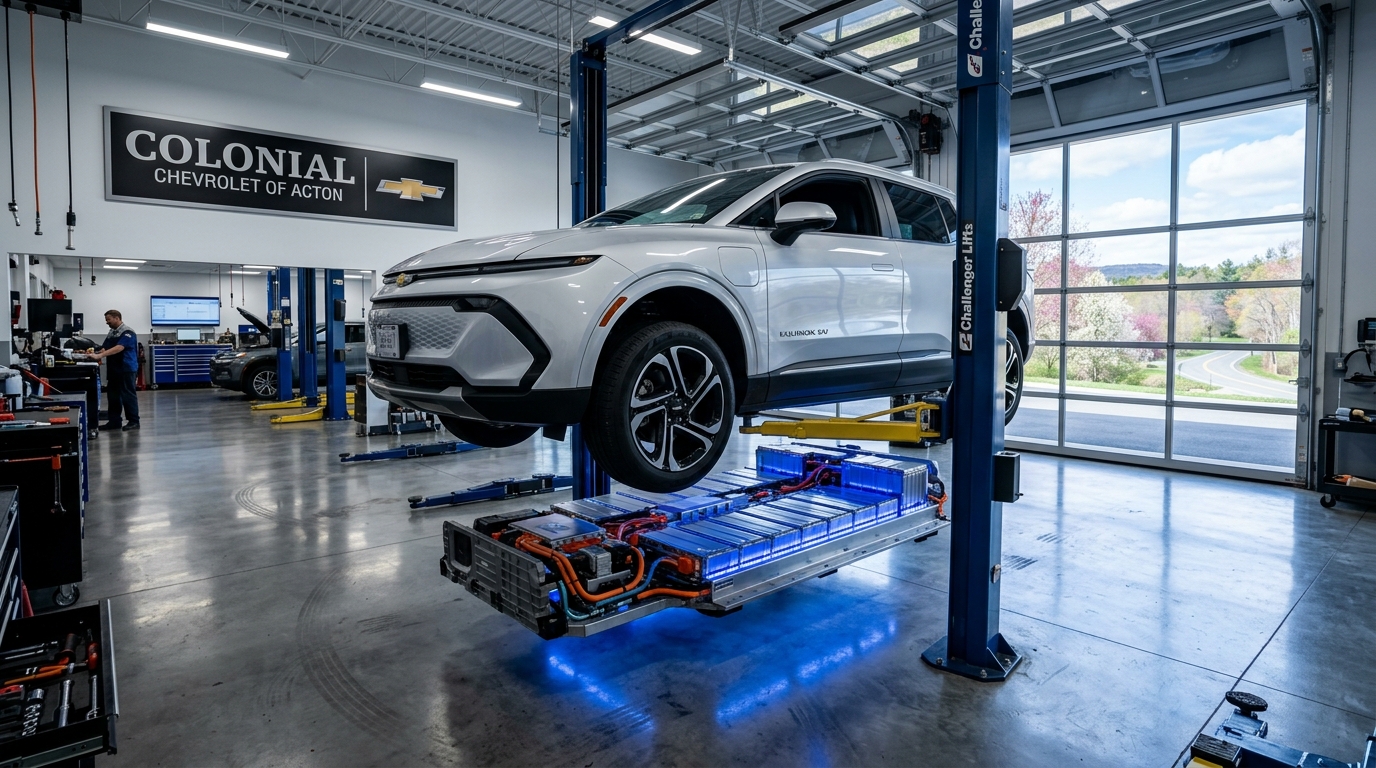
Optimizing 2026 Chevrolet EV Battery Longevity and Performance
The 2026 Chevrolet Equinox EV and its Ultium-platform siblings represent a significant shift in vehicle longevity, moving the focus from oil pressures and exhaust backpressure to thermal management and cell chemistry. Maintaining these high-voltage systems requires a proactive approach to software and environmental factors rather than traditional mechanical adjustments. Because these vehicles rely on sophisticated cooling loops to keep the battery within an ideal temperature range, ensuring the underbody remains free of heavy debris and salt is a critical first step for local owners.
During the winter months in Acton, sub-freezing temperatures can impact chemical reactions within the battery cells, often resulting in a temporary range loss between 15% and 30%. Utilizing the vehicle’s preconditioning feature while it is still plugged into a charger uses grid power to warm the battery pack to its optimal operating temperature, preserving the stored energy for the actual drive. If you have questions about how local weather patterns affect your specific model, you can reach our service advisors at (978) 206-1952 for personalized guidance on seasonal care.
Software is the heartbeat of 2026 Chevrolet electric propulsion. Many optimizations for the Ultium battery pack are delivered through over-the-air updates, which refine how the Battery Control Module manages individual cell voltages. However, some critical diagnostic deep-dives and hardware-level recalibrations are best handled in a controlled shop environment. For those who prefer an in-person consultation regarding their vehicle’s performance, our service center location is equipped with the specialized high-voltage tools required to interface with the 2026 Chevrolet Blazer EV and Silverado EV platforms.
Table of Contents
- Essential Maintenance Requirements for Ultium and High-Voltage Systems
- Charging Habits and the Impact on Long-Term Battery Health
- Predictive Diagnostics and Professional Battery Health Inspections
- Long-Term Ownership Savings and Maintenance Cost Comparisons
- Common Technical Questions Regarding Chevrolet Electric Propulsion Service
Essential Maintenance Requirements for Ultium and High-Voltage Systems
Owners often ask if “no oil changes” means “no maintenance,” but the reality is that 2026 Chevrolet EVs simply trade internal combustion tasks for high-voltage system care. The primary maintenance heartbeat for models like the 2026 Chevrolet Equinox EV is the tire rotation, which should occur every 7,500 miles. Because electric vehicles deliver instantaneous torque and carry significant battery weight, tires can experience accelerated shoulder wear if not moved regularly. During these visits, our technicians also perform a comprehensive brake inspection; while regenerative braking reduces physical pad wear, the mechanical calipers still require periodic lubrication to prevent seizing, especially in our salt-belt environment.
The thermal management system is another critical area that requires professional attention over the long term. While the high-voltage coolant in a 2026 Chevrolet Blazer EV is designed for longevity, it eventually requires a flush—typically at the 150,000-mile mark or every five years—to ensure the heat exchangers remain efficient. Neglecting the cooling system can lead to reduced charging speeds, as the vehicle will throttle the intake of power if it cannot effectively dissipate the heat generated during a fast-charge session. To keep your vehicle’s maintenance on track, you can easily book a time for a multi-point inspection through our online portal.
Beyond the high-voltage pack, the cabin air filter remains a vital consumable that should be replaced every 12,000 to 20,000 miles. A clogged filter doesn’t just impact air quality; it forces the HVAC system to work harder, which can slightly decrease your overall driving range. We frequently offer seasonal incentives on these routine items, so it is always worth checking our current maintenance and parts vouchers before you visit. By staying ahead of these small requirements, you protect the 8-year / 100,000-mile battery warranty that serves as the foundation of your EV ownership.
Charging Habits and the Impact on Long-Term Battery Health
How you “fuel” your vehicle daily has a more direct impact on component health than almost any other factor in an electric drivetrain. For daily operation of a 2026 Chevrolet Silverado EV or Equinox EV, the industry standard is to maintain a state of charge between 20% and 80%. Consistently charging to 100% or allowing the battery to dip into single digits can put undue stress on the lithium-ion chemistry, potentially accelerating capacity degradation over several years. We suggest reserving a full 100% charge exclusively for long-distance trips where the maximum available range is necessary.
The choice of charging hardware also plays a significant role in the lifecycle of the Ultium battery system. While DC fast charging is incredibly convenient for travel, relying on it as a primary daily source can lead to increased heat-related wear. For the most reliable long-term health, Level 2 home charging is the preferred method. If you are looking to upgrade your home setup, you can find authorized Chevrolet charging accessories through our parts department, including the GM PowerUp Level 2 Charger which is compatible with the entire 2026 EV lineup.
In Bedford, commuters who utilize public charging infrastructure should be mindful of “cold soaking.” If a vehicle sits in sub-freezing temperatures for an extended period, the battery will initially accept a charge at a much slower rate to protect the cells. Using the vehicle’s navigation to route to a charging station allows the system to initiate “thermal pre-conditioning,” warming the pack en route so it is ready to accept the maximum possible kilowatt rate the moment you plug in. This small habit saves time at the plug and reduces the total stress on the high-voltage contactors.
Predictive Diagnostics and Professional Battery Health Inspections
The Battery Management System (BMS) in the 2026 Chevrolet EV lineup constantly monitors the voltage of individual cell modules, looking for variances that might indicate a weak point in the pack. However, a professional health check involves more than just reading dashboard codes. Our technicians use specialized diagnostic software to pull “State of Health” (SOH) percentages, which provide a clear picture of how much of the original energy capacity remains as the vehicle ages.
These inspections are particularly valuable for owners in Stow who may deal with more rugged terrain or gravel roads that could impact the underbody shielding. While the battery packs are encased in high-strength steel, a physical inspection ensures that the protective plates and cooling lines haven’t sustained impact damage. We also check the 12-volt auxiliary battery during these sessions; even in an EV, the 12-volt system is responsible for “waking up” the high-voltage computers and powering safety systems like airbags and lighting.
Routine health checks also ensure your vehicle is current on all module calibrations. Sometimes, what appears to be a loss in range is actually a software “drift” where the computer’s estimation of remaining energy becomes less accurate over time. A professional reset and recalibration can often restore the accuracy of the range estimator, providing more peace of mind during longer commutes. These predictive measures are designed to catch minor electrical inconsistencies before they ever trigger a warning light on your instrument cluster.
Long-Term Ownership Savings and Maintenance Cost Comparisons
When comparing the maintenance profile of a 2026 Chevrolet Equinox EV to a traditional gasoline-powered SUV, the financial benefits of the electric platform become clear over a multi-year horizon. A gas-powered vehicle requires dozens of oil changes, multiple sets of spark plugs, air intake filters, and potentially timing belt or transmission fluid services within the first 100,000 miles. In contrast, the Equinox EV eliminates these high-heat, high-friction components entirely. Estimates suggest that EV owners can save roughly 50% on routine maintenance costs compared to internal combustion counterparts.
The 8-year / 100,000-mile battery warranty (with some variations for CARB-compliant states) provides a safety net that gasoline engines simply do not have. While a traditional powertrain warranty often ends at 60,000 miles, Chevrolet stands behind the electric drive components for significantly longer. This extended coverage reflects the inherent durability of electric motors, which have only one primary moving part compared to the hundreds of reciprocating components in a V6 or turbocharged four-cylinder engine.
Even wear-and-tear items like brakes follow a different cost curve. Thanks to regenerative braking, which uses the electric motor to slow the vehicle while recapturing energy, the physical brake pads on a 2026 Chevrolet Blazer EV can often last twice as long as those on a gas vehicle. While the initial investment in an EV can be higher, the reduction in recurring trips to the service bay for fluids and filters creates a lower total cost of ownership that becomes increasingly apparent the longer you keep the vehicle.
Common Technical Questions Regarding Chevrolet Electric Propulsion Service
Q: Do I need to bring my 2026 Chevrolet EV in for service if there are no warning lights?
Yes, regular visits are still necessary for tire rotations every 7,500 miles and multi-point inspections. These visits allow technicians to check the high-voltage cooling loops, suspension bushings, and steering components that are under higher stress due to the vehicle’s weight. Catching a small alignment issue early can save you from having to replace an expensive set of EV-specific tires prematurely.
Q: How does the cold weather in Massachusetts affect my battery warranty?
The 8-year / 100,000-mile warranty covers defects in materials and workmanship, as well as excessive capacity loss. While cold weather temporarily reduces your range, it does not permanently “break” the battery or void your warranty. Using the recommended pre-conditioning steps while plugged in helps the battery manage these temperature swings without unnecessary strain.
Q: Can any local mechanic service the battery in my 2026 Silverado EV?
High-voltage systems require specialized training and insulated tools to be serviced safely. Most general repair shops are not equipped to handle internal battery repairs or high-voltage coolant flushes. It is vital to use a certified facility like our Acton service center to ensure that all work complies with factory safety standards and preserves your warranty.
Q: What happens if my battery capacity drops below a certain level?
The Chevrolet battery warranty typically protects against capacity degradation if the pack falls below a specific percentage of its original state (often 60% to 70%, depending on the specific model terms). If a diagnostic test confirms the pack has degraded beyond this threshold within the warranty period, the system is eligible for repair or module replacement.
Q: Is there a specific “break-in” period for a new 2026 Chevrolet EV battery?
Unlike gas engines, there is no need for a 1,000-mile oil change or varied-speed break-in. However, we recommend avoiding extreme DC fast charging for the first few hundred miles to allow the battery cells and thermal management system to stabilize. After that, following standard 20% to 80% charging habits is the best way to ensure long-term performance.
If you have more specific questions about your vehicle’s high-voltage system or need to discuss a specific service concern, please give our team a quick call. We are here to help you navigate the transition to electric driving with confidence and expert technical support.
© 2026 Colonial Chevrolet. All rights reserved.
Connect with us


